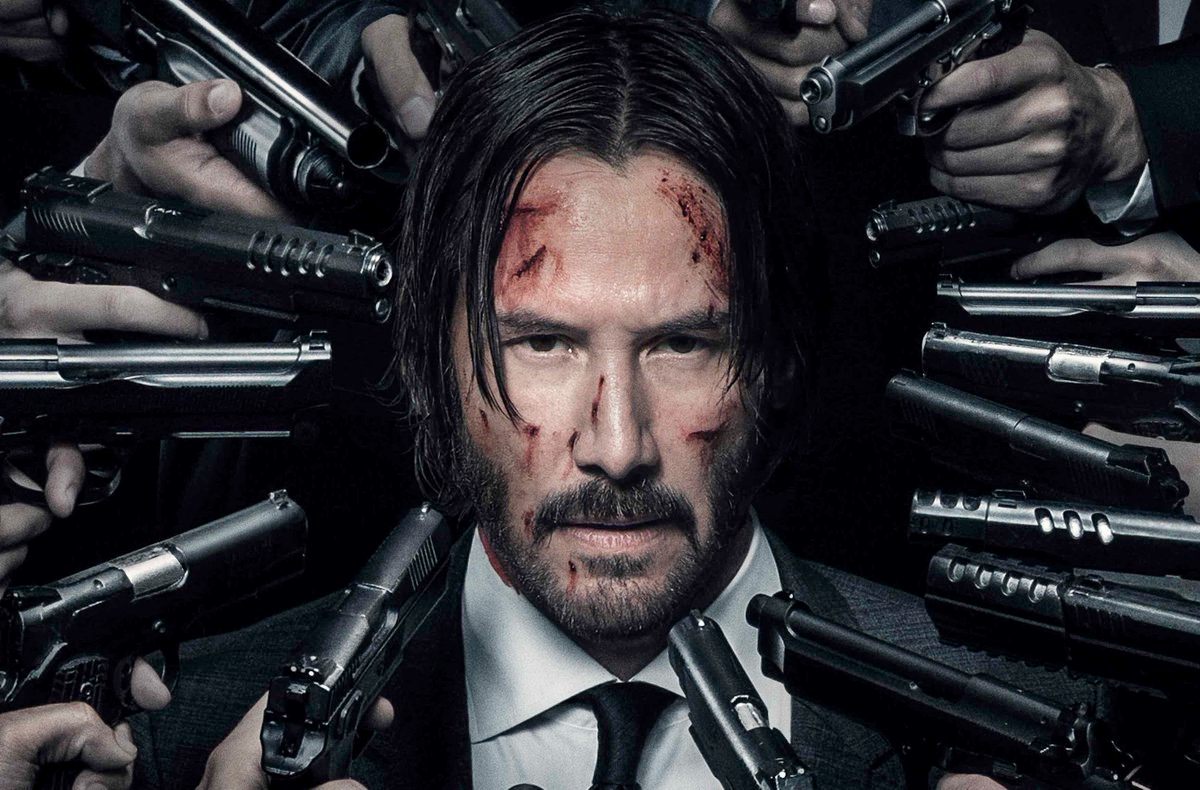
I’m not sure why, but I have not watched any of the John Wick movies up until now. Since my TV viewing has slowed a bit, I’m making time to catch up on my movie watchlist (which is really too infinite to think about), and I just watched all four John Wick movies nearly back to back.
It’s been almost 10 years since the start of the series, but after I missed the first one, I assumed that the second, third, and fourth chapters would just be more of the same. I found that assumption to be both true and untrue as the series seems like one endless battle of John Wick versus the many assassins who are sent to kill him; however, I never expected all the mythology and world-building used to enhance such a simple premise. Keanu Reeves is the perfect actor for the role (or he really made the role his own) because I cannot imagine another person playing John Wick. It struck me probably by the second movie that there were also a lot of similarities between the John Wick franchise and the Matrix franchise — obviously not in subject matter, but in the way they are both stylish and modern, dressing Reeves’s stolid, lone-wolf protagonist in black and feeding him an endless stream of allies and enemies, most of whom are given delightfully archetypal and mythical nicknames such as Zero, Tracker, Caine, Charon, Ares, The Elder, The Bowery King, The Harbinger, and The Adjudicator (reminding me of The Matrix‘s Tank, Cypher, Trinity, Morpheus, Persephone, The Oracle, The Architect, and my favourite: The Merovingian). Both of these iconic Reeves characters are the unlikely, unwitting heroes who don’t seek to lead or to be the ones at the centre of everyone’s attention, but circumstances push him into the spotlight — all he wanted to do was get some gasoline for his car, and spend some time with his dog. Reeves also has that slightly over-paused delivery of the few lines that he’s given (between fights) where it feels like he’s forgotten the full dialogue so he shortened it to whatever he can remember. It’s odd, but it kind of works, for the character that he’s playing.
If you’re reading this post, I am assuming that you already watched most, if not all, of these John Wick movies, but I’m still going to go through the four, making a few comments on each one. Let’s hope that I can remember what happened in them, since they kind of blend.
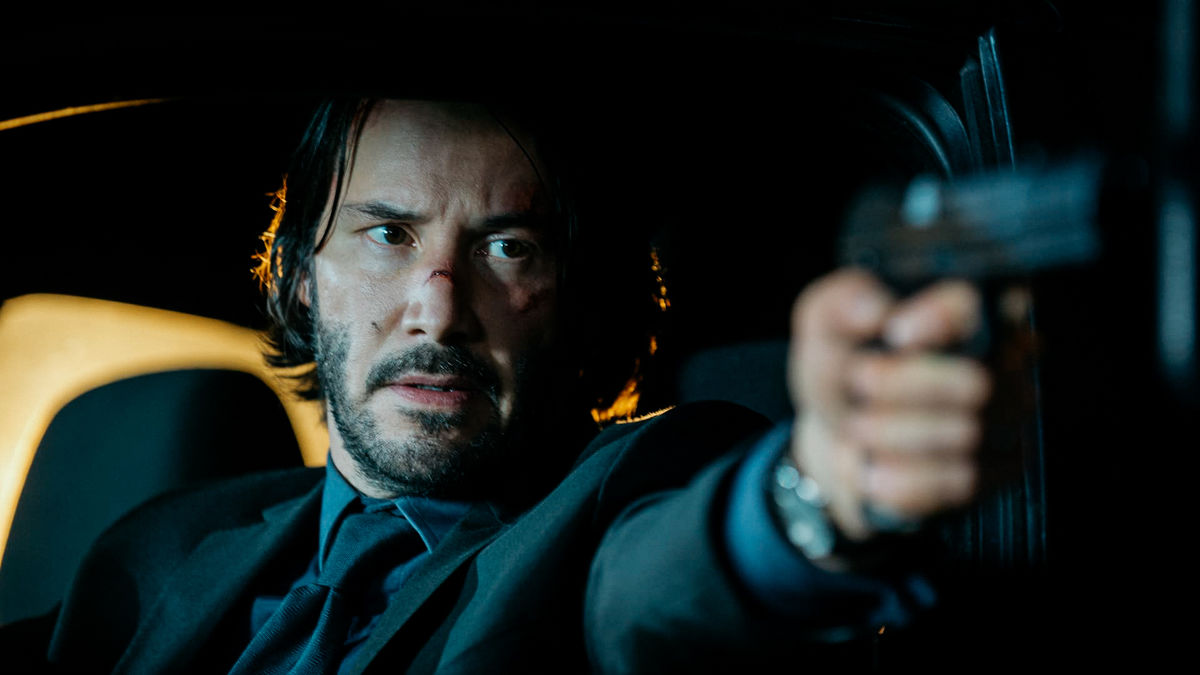
John Wick (2014)
I’m not sure if the filmmakers already knew from the first film how far the franchise would go by the fourth, but this one was definitely the most basic of the lot. It’s become a running gag that the exponentially escalating cycle of death and revenge all started because Iosef, the son of a Russian mobster Viggo, stole John Wick’s car and killed John Wick’s dog. Even in this relatively down-to-earth revenge story, Wick’s response seems to be out of proportion, but (as the movie keeps reminding us) it’s all for sentimental reasons. When Iosef and his thugs attack Wick in his home, we already get a good sense of the heightened level of well-choreographed violence that becomes a trademark of this series, and the largest portion of the fun. As Viggo reminded us and Iosef, in his former life as a top assassin Wick was legendary for his lethalness, having once killed a bunch of men in a bar with just a pencil (which he later demonstrates again). Another element in this first movie that sets precedent for later chapters is how the reality of the movie is completely in service to the fight scenes. I almost laughed out loud at the way the climactic car chase scene of Viggo’s men coming after Wick led to a mano a mano confrontation between the two men that was drenched in a sudden downpour — we’re talking torrential rain. It was clearly meant to set the mood of the fight, but it was so blatant that it was actually kind of funny. When circumstances bring John Wick back into this assassins’ underworld, we get introduced to the other big through-line of the series: The Continental — the upscale hotel chain that caters to the elite assassins and dark dealers of this underworld, and by the end of the film we get a little glimpse of the rules and ceremony that govern it, would play a major role in the plot of the rest of the series, and ultimately lifts the series above your average hitman story.
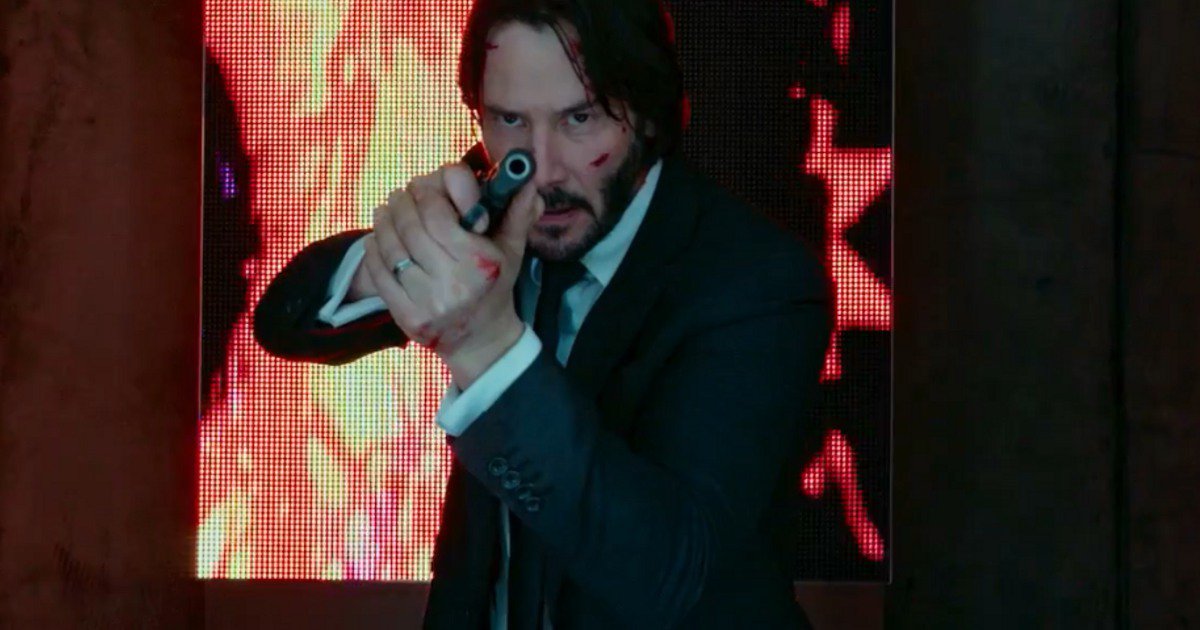
John Wick: Chapter 2 (2017)
The second movie was when mythology of The Continental, the secret-society-style rules, and the governance of the High Table (who are the ruling body of this world, comprised of representatives from the leading criminal families/factions) really starts to come out. It seemed like scores had been settled (many times over) in the first movie, but then John is visited by Santino, an Italian crime lord to whom John owed a marker (which is a very binding debt in the world under the High Table, complete with a bloody fingerprint on a talisman to seal the deal). This obviously contrived inciting incident takes John to Rome (which adds a Da Vinci Code flavour to the mix). Where better to blend European dance clubs and quasi-religious rituals? Of course, even after John fulfills his pledge and kills Santino’s sister, he turns on John and puts out a contract on his head. I think I liked this movie best of the lot because I love all the underworld stuff, like the Accounts Payable department of tattooed women operating old time computers and phones in order to handle and communicate the various hit contracts; like the many services of The Continental, including how the Sommelier was a weapons rather than wine specialist (though he could probably come up with some good meal pairings as well) and the tailor would craft the latest in kevlar-lined suits (which would also become a staple of the series). All this crazy mythology was at its most fun in the second movie, and while it was still a pleasure, they really went over the top in the last two chapters. I also enjoy the big name guest stars in these movies. In the first film, Willem Defoe played a wonderful frenemy of John’s, but I even more enjoyed Laurence Fishburne making his debut as the Bowery King in this second chapter. It’s in hindsight that I crown this second chapter my favourite, but as I was watching them, I definitely got swept up in flow of the overall story as it kept going on to the next chapter.

John Wick: Chapter 3 – Parabellum (2019)
In many ways, I enjoyed chapter three the least of all these movies. I don’t love the pretension of the Latin in the title (which later gets hammered home when Ian McShane’s Winston quotes the phrase “Si vis pacem, para bellum”). I didn’t love that John Wick was on his own after having killed Santino within the grounds of The Continental, thus breaking its number one rule and earning an “excommunicado” status and the contract on his head. I found celebrity guest star Halle Berry pretty meh. She didn’t fit into this world of slick assassins, but at least she helped establish another rule: assassins have the best helper dogs. Even Anjelica Huston (who is always an amazing guest star) was only OK as John Wick’s former matron within the Belarusian guild which apparently raised him and brought him into this world. This movie introduced Asia Kate Dillon, who I actually liked as The Adjudicator, the uptight agent of the High Table who assesses and sentences guild offenders. But it also introduced the ridiculous role of The Elder, who supposedly sits above the High Table, but seemed to be just another red herring in this convoluted mythology meant to waste John Wick’s time. On top of all that, I found the fight scenes a bit frustrating. They were still well done, but what was with all the Asian thugs fighting John Wick having to continuously make “hiya!” noises with every blow. It felt offensive and kinda racist. Also, when they were all fighting underneath The Continental, why were there so many neon-lit glass cases for tossing John Wick into? If I had a drink every time they shattered one, I might have enjoyed the movie a bit more.
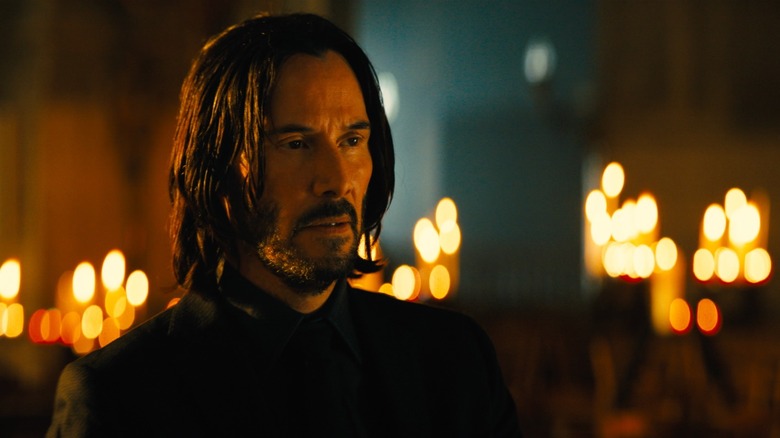
John Wick: Chapter 4 (2023)
Finally, the last(?) instalment in the series was a pretty good conclusion. It brought back a lot of echoes and elements from all the previous chapters but also added unique things. I liked that there was an antagonist for John Wick in the Marquis character (played pretty well by the appropriately eurotrashy Bill Skarsgård). I liked that we got a much bigger role for Lance Reddick, as Charon, the concierge of The Continental, who’s been a low-key bright spot in every movie in the series. As an opponent to John Wick, martial arts superstar Donnie Yen, who uttered nary a “hiya!”, was much better than I expected (though his Caine was implausibly skilled and deadly for a blind man). I’m not sure if that was meant to be a shout-out to the differently-abled in the audience, but it felt a little bogus to me. Nevertheless, he was way better than the laffable use of Brit action star Scott Adkins in a fat suit as the gangster named Killa (a bit on the nose?). I still don’t understand the thinking there, as Adkins is a good-looking, super-fit stuntman and fighter. Why on Earth would they put him in an insulting prosthetic to have him fight John Wick? Their scene was hilarious in other ways too: as Wick chased Killa through the night club, the dancers in the background never stopped dancing even when the two men were beating and shooting each other (The DJ must have been spinning some really compelling music!); and also, when Killa chucks Wick over the side of a two-storey waterfall, landing him on a concrete floor, he then gets up not long after with almost no injury! Despite some missteps, it’s awesome that this film series has gone to many of my favourite cities and locations in the world. I love that this last film started in Japan (at the Osaka Continental, which also had tons of neon-lit glass cases to throw John Wick into) and ended in Paris — one of the most iconic and beloved cities in the world, including by me. I haven’t commented too much on the action/fight sequences in the movies, but they are typically quite creative and thrilling. There have been scenes in cars, on horseback, in the rain, on the train, in the park, and I’m sure I’ve forgotten many of them but they’re all good. One of the most unforgettable, however, was the last one in the series: up the steps to Sacre-Coeur Cathedral in Paris. Not only did we feel the tension of John Wick rushing to the top for his appointed duel vs the Marquis, but he was met by dozens of thugs on the way, hoping to get the bounty on John Wick (which I think had reached $40 million by then). Fight after fight was exciting to watch, but watching him tumble all the way down the 300 steps was heart-breaking. Thankfully he made it back up in time for the climactic pistols at dawn. There’s a lot more introspection and emotional conversations between characters in this last film, and I think it makes for a nice ending for an action franchise (that’s why I hope they don’t try to squeeze out a John Wick 5).
Overall I really enjoyed my viewing of the John Wick series. All get 4 out of 5, except Chapter 3, which is a 3.5. I think they are deservedly blockbusters, and I am glad that I finally watched them. They were finely-polished, great-looking action films enhanced with the kind of crazy made-up mythology that I love. I enjoyed all the little details, like how John Wick constantly had to reload his gun; how while wearing these bogus bullet-proof tailored jackets, he always held up his arm to shield himself from gunfire; and how he paid for everything with large gold coins. It’s a very fun series, no doubt, and congrats to Keanu for finding another iconic character that fits him to a T (or a black kevlar suit).
 Alvin's Adventures in Pop Culture