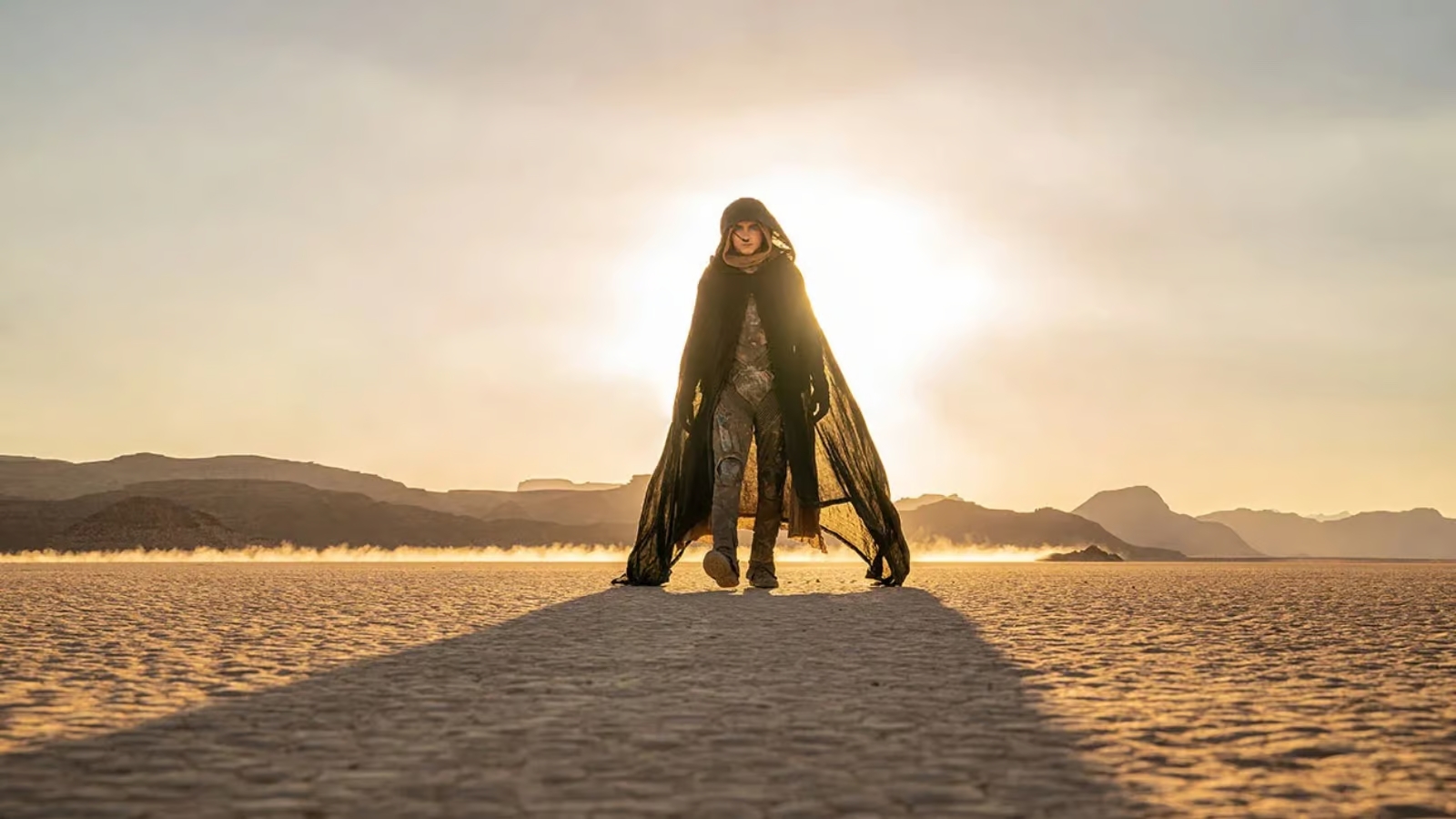
The first part of Denis Villeneuve’s adaptation of Frank Herbert’s classic sci-fi novel Dune was amazing. Visually stunning, it delivered an engaging story that brought Herbert’s characters to life and made this incredible, fictional universe feel very real. This second part continues right where the first film left off: Paul Atreides (Timothée Chalamet) and his mother Jessica (Rebecca Ferguson) join with the desert people, Fremen, to escape the forces of House Harkonnen, who have attacked and destroyed House Atreides. While with the Fremen, Paul contends with a prophecy that he could be their messiah, who will lead them to freedom and paradise. Also, Jessica, as a member of a powerful order of female mystics known as the Bene Gesserit, struggles with filling the role of the Fremen’s spiritual leader, the Reverend Mother. While helping the Fremen to fight against the Harkonnen, Paul and Jessica are bound deeper with the Fremen community, and Paul’s romantic relationship with Chani (Zendaya) also develops and grows.
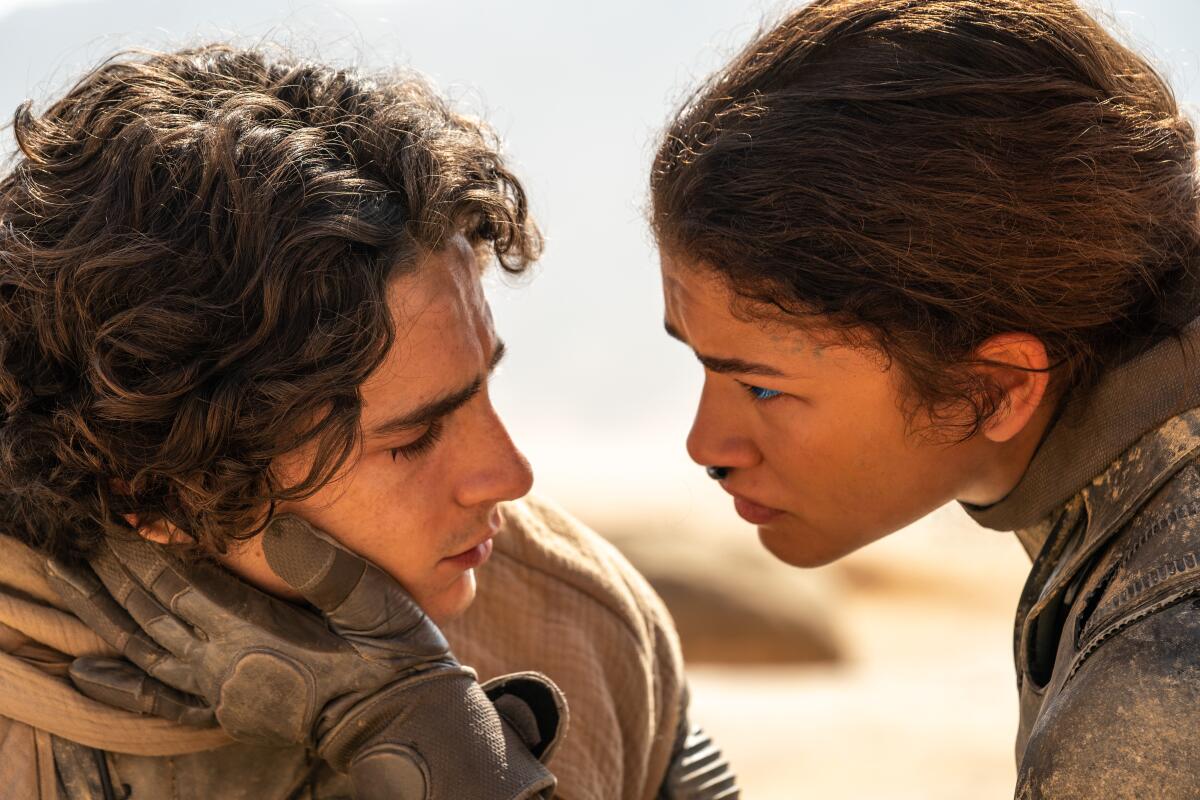
Even though not much time truly elapses (we can measure time by watching as Jessica grows more pregnant with her daughter through most of the movie), Paul rapidly matures from the adolescent that was in the first film, to become a capable warrior and prophesied leader. Chalamet was pretty good as the young Paul, but I was less sold on his quick transformation into the legendary Muad’Dib (an iconic name that he chooses for himself), despite some calling this Chalamet’s best performance ever (I don’t know much about acting, frankly, so they may be right). Overall, there was so much plot to get through (even though the movie was close to 3 hours) that I don’t think there was enough screen time given to the character development and growth. Also, as part of Villeneuve’s style (which I don’t hate), many character scenes are moody (with less dialogue) rather than full of interaction. That also left me somewhat unconvinced of the love story between Paul and Chani. I know a lot of people praise Zendaya as an actress, but I don’t really enjoy her performances. I have admittedly not watched many of her roles (in particular, I have not watched her star-making performance in the series Euphoria), but in what I have seen she always seems kind of smug and indignant, and that’s how her Chani feels as well. Ferguson’s portrayal of Jessica was cold and only got more so as she embraced her spiritual role, it suited her. One character that had not really been on my radar that I actually enjoyed was Stilgar, a Fremen leader (played by Javier Bardem) who takes Paul under his wing and has a fervent belief in Paul’s prophetic destiny. His role was much bigger in this second film and I admired Stilgar as a strong leader and man of faith (it was a funny scene when he shushes Chani and another Fremen for giggling while he and others are praying).
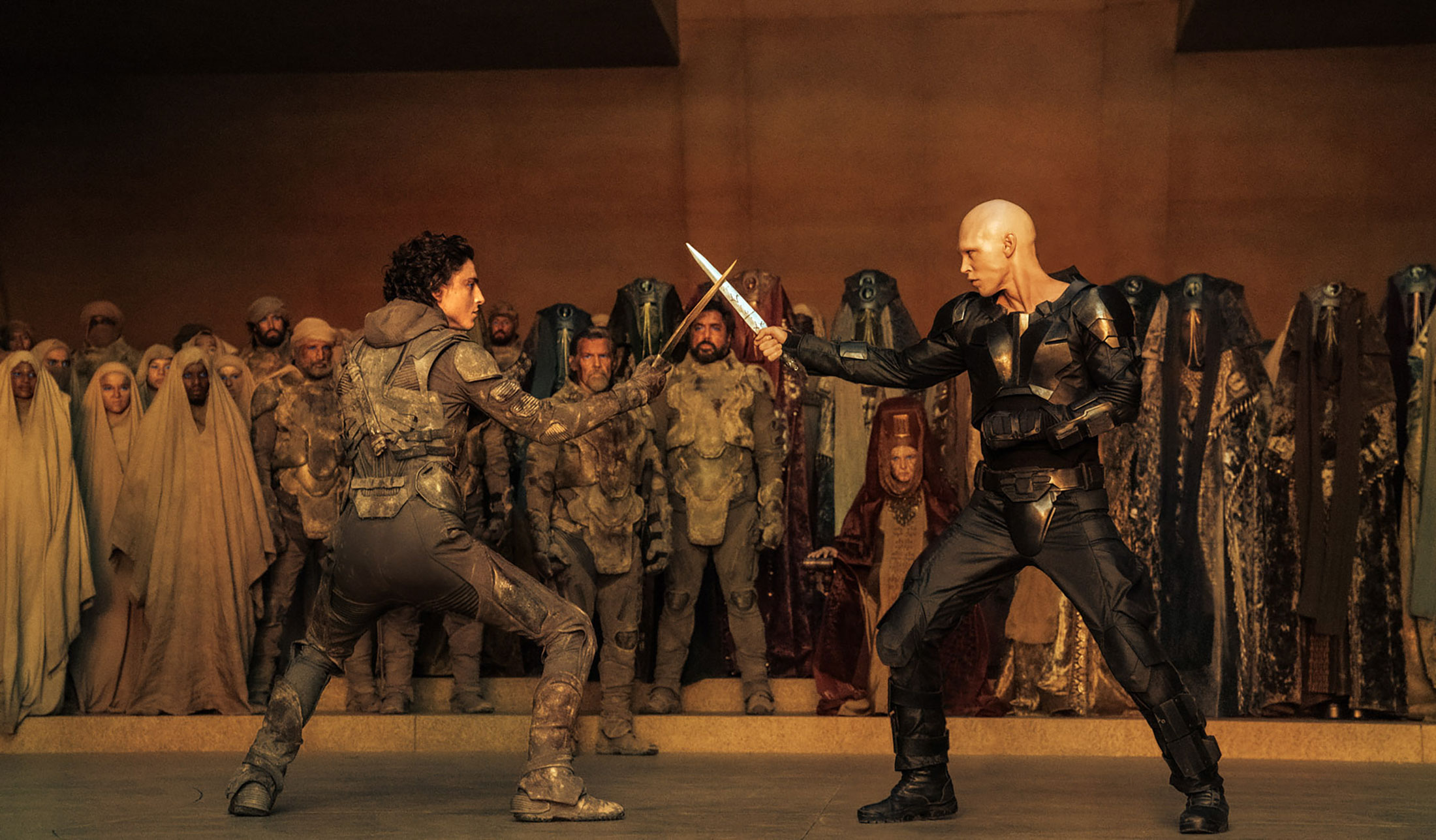
There were also two highly-anticipated (and hyped) roles in Part 2 who were not in the first film: Princess Irulan, and Feyd-Rautha Harkonnen. Irulan is the daughter of Padishah Emperor Shaddam IV (I love the sound of that name! But I was unimpressed by Christopher Walken in the role: it made me pause and wonder “Why are so many characters speaking American?”). Irulan is played in this movie by Florence Pugh (one of my favourite actresses, mostly for her performance in Little Women and especially Black Widow). Alas, she doesn’t have very much to do, so Pugh is hardly stretching her acting skills. Much like Natalie Portman’s portrayal of Amidala in the Star Wars prequels, she seems there mostly to look good in exotic costumes. Austin Butler’s role of Feyd-Rautha, the psychopathic nephew to odious Baron Vladimir Harkonnen (Stellan Skarsgård), has a bit more screen time. In fact, he has a couple of scenes almost devoted to him, that Villeneuve chose to film as quasi-black-and-white (which I think was meant to be a nod to the alienness of the Harkonnen home world of Giedi Prime rather than some kind of flashback or other cinematic choice). Butler’s golden-boy good looks were somewhat obscured by the white, smooth, plastic makeup applied to make Feyd look like a Harkonnen (he kind of resembles one of those creepy-looking Engineers from Ridley Scott’s Prometheus). Butler affected a kind of odd speaking style (and maybe accent) for the role. He didn’t really speak enough for me to hear it clearly, but it sounded weird. Most of his scenes (including a stylish gladiator scene) had him cutting and slicing people on whim up until his anticipated final showdown with Paul.
Though I’ve mostly discussed the characters and a bit of the acting, this movie (like the first one) is a lot more about the visuals and the action. It’s clearly no simple feat to bring a fictional universe to the screen, yet Villeneuve and his team have brought it and with style to spare. I was surprised to learn that this film was made for a similar budget to the recent MCU movies like The Marvels and Ant-Man: Quantumania. While those other movies also have a very polished look and lots of visual effects, Dune Part 2 appears to have infinitely more artistry in its world-building and art direction. Everything looks and feels beautiful and great to look at. The world (even though it’s technically only one small corner of a larger galaxy) feels expansive and vast. The starships and the battalions of soldiers have an impressive scope and grandeur. Also, Villeneuve (and/or his cinematographer and director of photography) has an impressive eye for composition, with many gorgeous scenes of the desert planet and its windblown sandscape (Somehow the sun always seem to be rising or setting just in time for a good shot). Of course, we can’t not talk about the worms. The famous sandworms of Dune did not get as much screen time as I’d expected. Nevertheless, there was always a sense of scale with them in every scene they appear, and the ominous thumper used to summon the worms is now as iconic as the cup of rippling water in Jurassic Park. The one thing I found kind of odd, worm-wise, was when groups of Fremen got on board the worms’ backs with tents and luggage, using them as commuter buses. It amused me to wonder how they all boarded the worms and how they could stay on top for the whole journey.
I won’t spoil details of the plot, but even though I found the climax of the movie to be quite thrilling and incredible, it also felt like it happened too suddenly and too easily. It felt like our heroes were helped along by the power of the plot itself, and that things played out as they did mostly because the story required them to. In fact, the whole movie kind of felt that way. Since prophecy is such a big theme in this movie, that made it feel even more obvious. It was almost like doubting the prophecy is basically the same as doubting the script. As a result, the plot lost some of its subtlety, characters were more going-through-the-motions, and outcomes didn’t feel as earned. Nevertheless, those are not the most important things for me when watching Dune. I already read the book (though I don’t remember most of the details) and kind of know where the story goes, so I was definitely along for Villeneuve’s ride. I felt as satisfied as most viewers did with the magnificent sci-fi spectacle of the film regardless of how the characters’ stories played out. Recently, many underwhelming adaptations have made it to the large and small screens, including the latest MCU movies and Amazon’s fantasy series such as Rings of Power and Wheel of Time. But over 20 years ago, Peter Jackson’s Lord of the Rings set a peerless gold standard for movie adaptions of fantastical stories. Now, I feel we can add Villeneuve’s Dune series alongside Jackson’s as another hallmark of excellence. (4.5 out of 5)
 Alvin's Adventures in Pop Culture