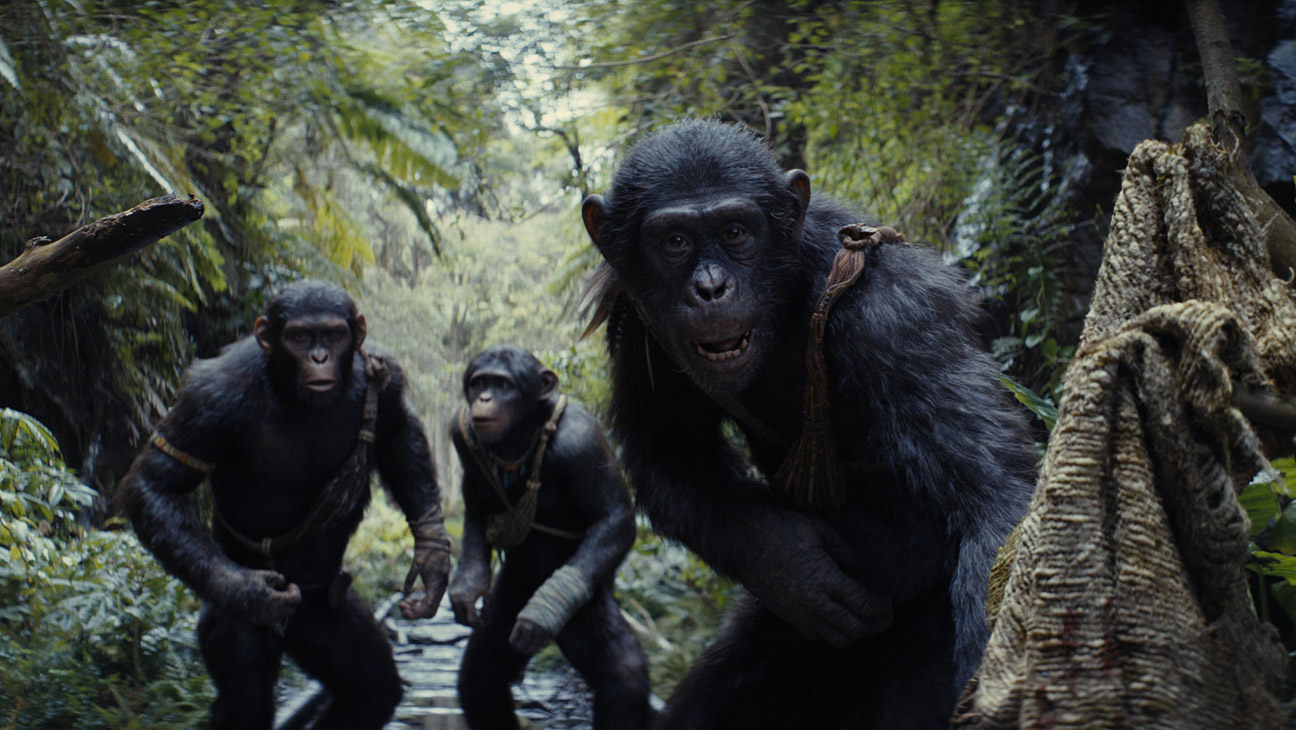
I never watched the original Planet of the Apes series of films (starring Charlton Heston back in the 1960s and 70s), but I am a fan of the recent trilogy of Apes films (2011-17) that told an origin story for what led the apes to take over the world from humans. (I also watched the 2001 Tim Burton/Mark Wahlberg remake which was interesting but ultimately kind of lame.) This latest fourth movie in the rebooted series finally hits that point which I think the original 1968 movie started from, where apes rule the planet and humans are wild, speechless animals (at least they appeared to be), but I think there were some problems with the timeline that were problematic for me. Also, after three great movies, this seems like a movie not one asked for, and has that “fourth movie in a trilogy” feeling – similar to The Bourne Legacy, Alien Resurrection, or the recent The Matrix Resurrections (at least they didn’t call this one “Resurrection of the Planet of the Apes”).
This movie starts with a prologue, calling back to the death of Caesar — the ape that started it all by being made smart in the first trilogy — and how “generations” later (the fact that they don’t tell you how long that is, is kind of telling), the apes have taken the world from the humans, kind of. We see some ruined buildings overrun by vegetation and there appears to be no real cities remaining. The apes rule in a loosely barbaric kind of society with small tribes of chimps ruled by gorillas and other larger apes.
The story picks up with a new protagonist, Noa, a chimp whose village trains eagles (which is kind of a cool idea) and there’s a great opening scene where he and his two friends (who form a classic trio of hero, girlfriend, and sidekick) risk life and limb climbing high to procure eagle eggs to hatch their own. Unfortunately, events start to turn after they get back to their village which is raided by a stronger tribe and everyone except Noa is taken prisoner. In the meantime, Noa catches glimpses of something that might be a human.
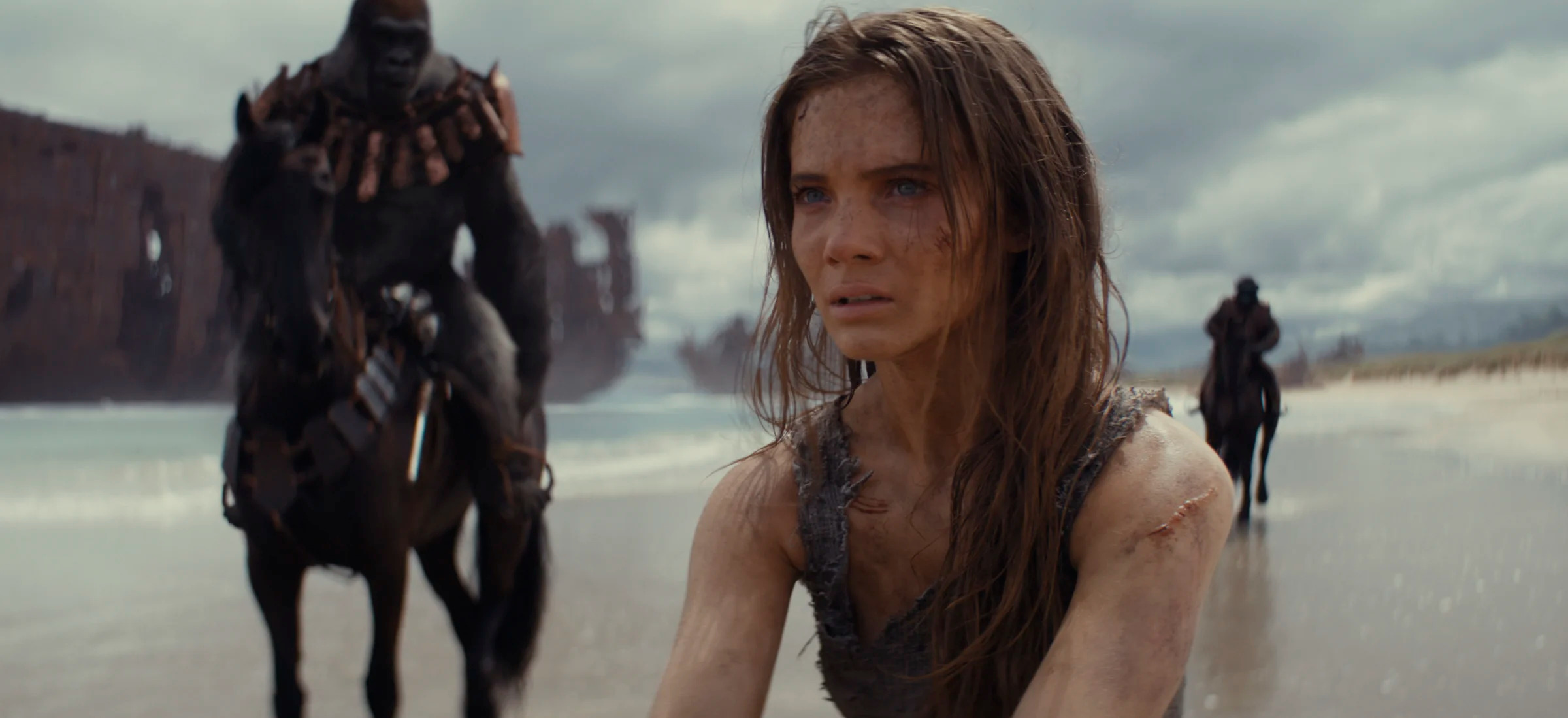
Setting on a rescue mission, Noa does encounter a human, played by The Witcher’s Freya Allen, on the way. He also teams up with a wise orangutan, Raka, and the three head towards the surprisingly distant place where the villagers have been taken, with plans to rescue them from the warlord ape known as Proximus Caesar.
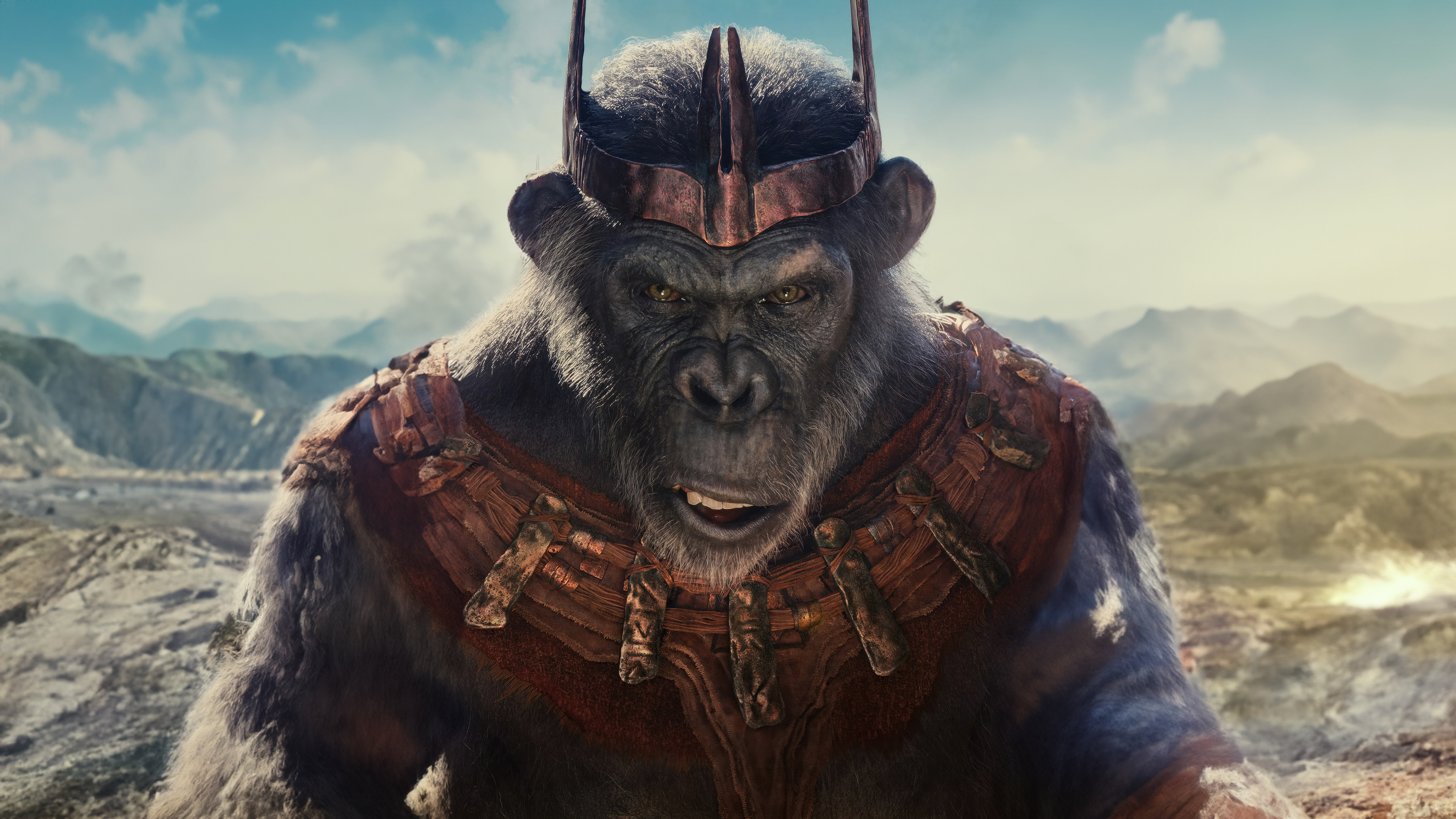
While this movie’s visuals and effects are really impressive, with the talking apes being amazingly realistic and the action sequences being kinetic and thrilling, the story is a bit less excellent. From the title of this film, I had expected a much broader scope and larger scale to the story. I had expected hundreds of years after our current time and a whole ape society to have developed. I get that they are maybe trying to take “baby steps” in developing the entire history, but this intermediate stage with roaming tribes and warlords is not too interesting. I don’t really care about the fate of one single village or about this one warlord and his tribe. The stakes that I thought were high became disappointingly reduced once I realized this. I kept wondering where this was taking place on the planet. It could all have just happened within a nature preserve or a national park. Maybe human society is still thriving in the metropolitan areas or more distant in another country. This hardly feels like a planet of apes.
As an overall story, a large scale narrative, there are a lot of unexplained plot holes (which arguably could have explanations, but none are given). If these events happen 60-80 years after a global viral pandemic has reduced humans to simple creatures while apes have become more intelligent, we still don’t know where the billions of simple humans have gone. There’s a brief scene with a dozen or so “wild” humans fleeing the apes in this movie, but that’s it. That doesn’t account for nearly enough people (and sorry to be morbid, but if a lot of humans ended up dying where are all the bodies?). Plus, a few grown-over highrises don’t hardly account for all the human infrastructure that must have been left behind, where are all the homes and vehicles? Bottom line is that telling a narrow story about a single village being captured by another tribe does not do the science fiction concepts of this franchise justice; and the epic title of the movie far overpromises.
Some comments have been made about the twist at the climax of this movie, which I won’t spoil except to say that it doesn’t come close to the ending of the original (which I’ve only heard of) where we learn that the planet of the apes was actually our planet (due to the sight of the Statue of Liberty). That sounds like it would have been an incredible twist back in its day. This one is kind of questionable and not entirely unpredictable. I’m not sure that it entirely holds water, logically, but as I’ve already commented, I don’t think they truly modeled the narrative on what might have logically happened after the smart-ape virus was spread and how much the world would have changed based on the time that had passed. Simply put, the logic is not good, so the ending feels contrived.
Overall, this movie nails the visuals pretty well. Apes are great to look at (even some extreme close-up scenes had me wondering how they were produced) and there’s a bunch of good action sequences. However, this movie suffers overall from the curse of today’s Hollywood franchise movies, which is that the writing is often weak and uninspired. Someone decides to green-light a mere concept (possibly just some elevator pitch regarding how they can continue or reboot a series) rather than someone making an imaginative, passion project come to life on the screen. The ending might suggest more sequels to come. I think I’d rather they just let the apes live in peace. (3 out of 5)
 Alvin's Adventures in Pop Culture