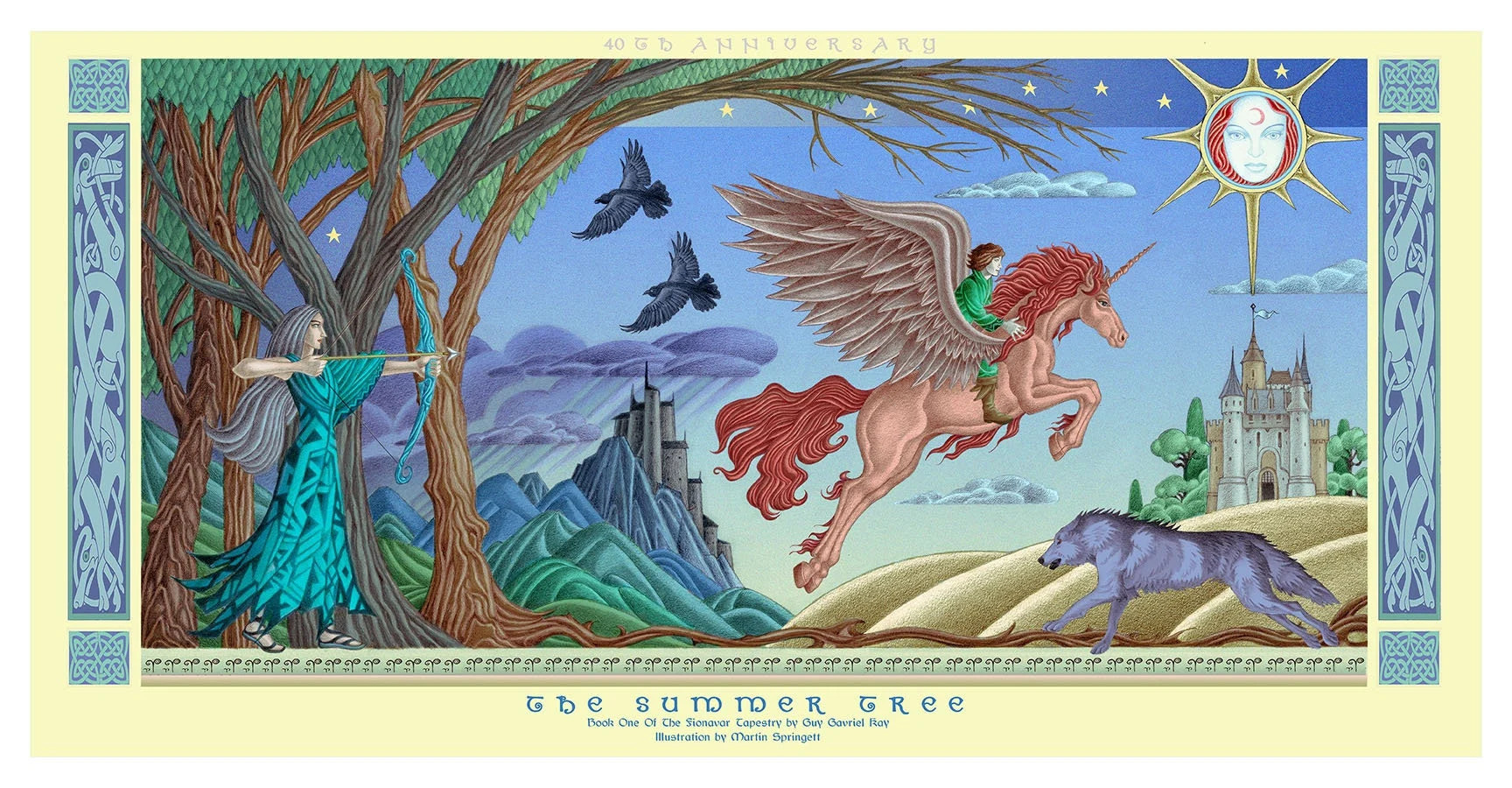
With our national pride in full bloom, I was eager to revisit a classic written by Canada’s premier fantasy author, Guy Gavriel Kay. I think I read The Summer Tree back in the 80s (for a class project on a Canadian writer), but sadly I have forgotten almost the entire story. Inspired in many ways by J.R.R. Tolkien’s Middle Earth, and C.S. Lewis’s Narnia, this story starts at the University of Toronto where a visiting lecturer, Prof. Lorenzo Marcus, reveals to five students that he is a wizard from another world — the prime world, known as Fionavar. Though there’s no wardrobe to walk into, Marcus (actually known as Loren Silvercloak) and his companion, Matt Sören (once king of the dwarves) brings the five magically back to their fantastical homeworld. First, how cool to read a story set where I went to school! Alas, they spent barely any time there before being whisked away. Like the Pevensies’ adventures in Narnia, these kids from our world end up playing a much bigger role in high stakes events in Fionavar. And while the initial setup seems similar, the story is much more modern (in the 80s) than the original Narnia stories (from the 50s). Nevertheless, it still struck me as a odd (and maybe even a bit dated) to have these characters arrive in a fantasy world and almost immediately start interacting with some of the most important people there.
Not long after arriving in Fionavar, our U of T characters, Paul, Kevin, Kim, and Jennifer, meet up with princes, showed up at court where wizards, priestesses and seers came to pay homage to the king, and even had secret meetings with the king themselves. The four split up and each character goes off with a Fionavar character on a kind of side quest and in a few days, they are deeply involved in this world — and a lot is going on here. Again, similar to Middle Earth, Kay creates a rich world full of magical kingdoms, heroes, and royalty, with an elaborate history and deep mythology. Though I enjoyed all of that storytelling and world-building, I also wished that we didn’t get so much so soon. It seemed a little fragmented and it seemed unreal that these characters went along with the ‘locals’ without really understanding what they were getting into. However, I guess that’s a pretty common trope in fantasy (especially this kind of “portal” or “isekai” fantasy where characters end up in another world). There isn’t time to let them get used to their new surroundings before events kick into gear. I was happier when, a third of the way in, the story shifted to focus on the fifth character, Dave, who was separated from the other four. He ended up with a community of hunter-gatherers called the Dalrei. This part of the story reminded me a lot of Daenerys Targaryen’s time with the Dothraki (in George R.R. Martin’s A Game of Thrones, which was written after this novel) — but with a lot less violence and sexual slavery. It set a slower pace, focusing only on one character making new friends among the folk.
Overall, Kay’s writing style is somewhere between the older stuff and the newer. It is beautifully written prose, with an epic grandeur, but it is less ornate than Tolkien’s. The many character scenes are intimate and grounded, often accessing the inner thoughts of the characters in a more modern way. The world is as expansive as many fantasy worlds (though I can knowingly only compare to a handful of them), full of human characters as well as dwarves, elves (light and dark), giant wolves, water gods and other deities, and of course, monsters and a supremely evil dark lord. Unfortunately, this first novel is mostly setup for the grand conflict of light versus dark. I’m expecting that the main conflict will probably come in the third part of the trilogy. In this first part, a lot of characters and forces have been introduced, which we will probably learn more about in the second book. Plus, we can see how our five heroes have already started to grow into the larger roles that they will play in the narrative as it weaves in more detail. (As in Robert Jordan’s The Wheel of Time (also written after this series), the weaving of a tapestry is also the overarching metaphor for life/fate/time in this series.) While I confess I don’t know all the characters well enough to feel fully invested in what’s to come, Kay has written a world that I like, and I am intrigued by everything that we’ve been introduced to so far. I am definitely excited to read on to book two, The Wandering Fire, and find out where things go from here. (3.5 out of 5)
 Alvin's Adventures in Pop Culture