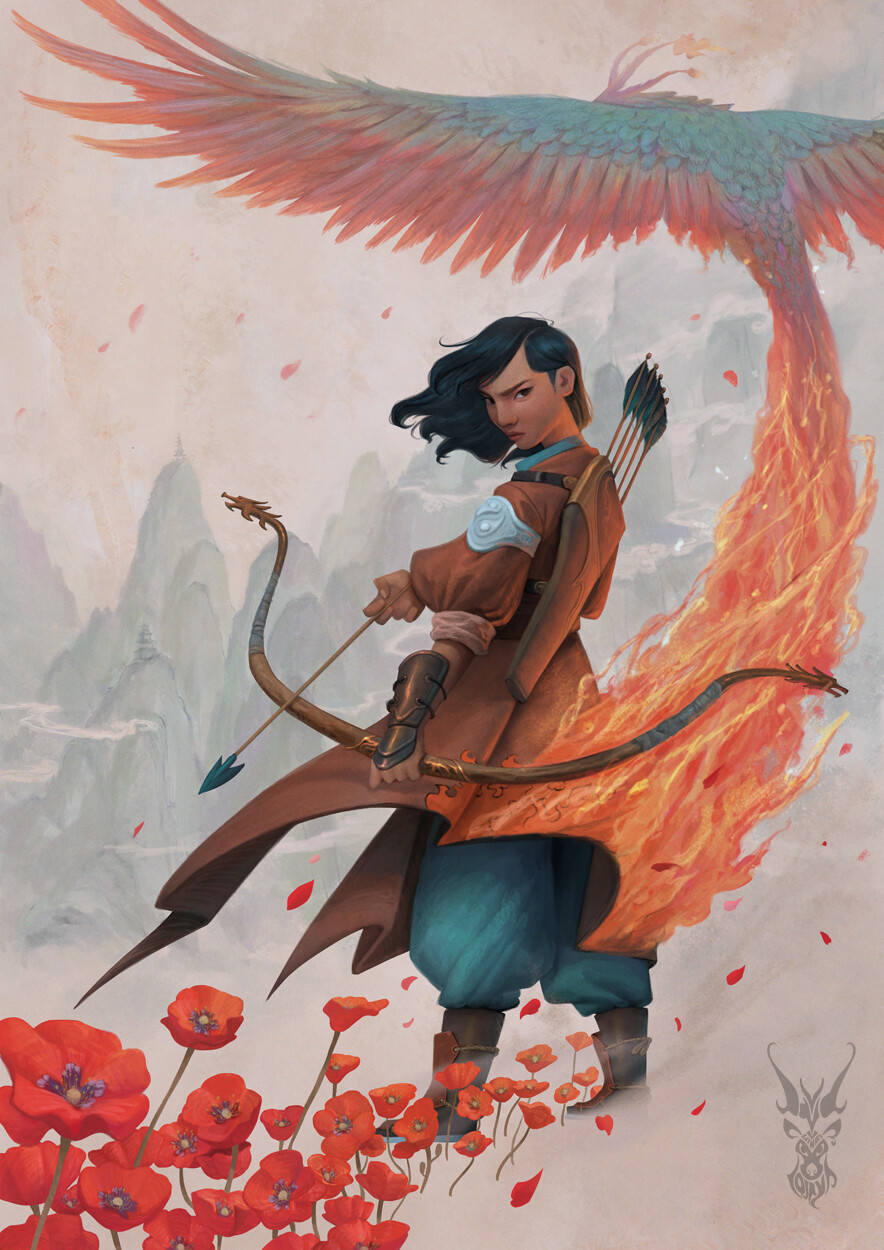
The Poppy War is a fantastical tale inspired by Chinese historical events (of which I am woefully under-educated) involving conflicts with Japan. The novel follows a young orphan named Rin, a foster child of opium dealers in a village in Nikan (a fictionalized China). In her efforts to leave an unhappy life of mistreatment, she studies brutally hard for the local placement exams and gets assigned to the top military school in the city of Sinegard. From there we follow Rin into a war between Nikan and Mugen (i.e. Japan), where eventually Rin discovers that she has poppy-induced magical powers that help her fight the war. The oversimplification of that synopsis reflects one of the things I disliked about this novel: the story arc is not well developed. While this is clearly meant to be a story set against a major war, the war is not actually in the foreground. Rin and her cohorts are in a couple of small-scale skirmishes, but the rest of the war happens offstage. They eventually come face-to-face with the horrific aftermath, and the climax of the novel is a very critical piece of the war, but we definitely don’t follow characters who are on the front lines. Rin’s adventures play out on their own, separately, while presumably thousands of soldiers are fighting on other battle fronts. Being on the fringes of this war (which is supposed to be the main driver of this story) doesn’t help establish a clear arc to the narrative. Throughout, I often wondered where the story was going.
Another aspect of the storytelling that didn’t help was that there was a weak sense of place or locale. There was very little detail given about the environment, and little indication when scenes had changed. More often scenes felt like floating conversations between characters, like plays where there are no sets other than black walls. It feels like the writing was intended for a television script, but without the TV visuals to place scenes in different settings this lack of location does a disservice to the overall narrative (which I already feel was kind of confusing and aimless).
The first part of the novel, with Rin in military school, felt full of “young adult” cliches: bullies, crushes, teenage insecurities writ large. Character dialogue felt too colloquial and anachronistic for something set presumably several centuries ago. The narration of the audiobook didn’t help as it only made the characters sound juvenile and bratty. Another recurring annoyance was how Rin was prone to speaking or screaming in a weepy tone of voice. It was aggravating, and by the end of the novel, whenever the text mentioned that she was upset, I cringed and braced myself for the narrator’s cry-talking voice again. Though the school parts were kind of bland, the novel amped up a bit once Rin discovered the idea of shamans, i.e. people in their world who could wield the magical powers of the gods, once triggered by opium/poppy-induced trances. (Though it was no fault of Kuang’s writing per se, I found myself chuckling every time it was mentioned that someone needed to acquire poppy seeds — possibly going to extreme lengths to do it. I kept thinking of what they could do if they’d only had a good bagel at hand.) Unfortunately, the magic wasn’t really that well thought-out, in my opinion, and ended up feeling like more of a plot device.
This brings me to my biggest issue with this novel, and unfortunately it gets deep into spoiler territory, so click here to expand only if you don’t mind being spoiled…
As I kept reading, I had a growing problem with Rin’s character, her attitudes and her choices. It started out merely that she was petulant and impulsive, her values and loyalties swinging wildly as other characters did things that she didn’t approve of. However, the massive plot turn of the atrocities in Golyn Niis put her over the top as a character. As an aside, if Golyn Niis was meant to be a parallel to the Nanking massacre, I am disappointed that Kuang used that historical atrocity/tragedy in this way in this novel. It seemed like it was exploited in order to manipulate the readers’ feelings without really much exploration of what happened. (A much more thoughtful examination of similar historical horrors, which also did not shy away from the gruesome details, was Ken Liu’s short story “The Man Who Ended History”.) The atrocities were used as an excuse to provoke Rin (and other characters) to rage and call the Mugenese “monsters” and “not human”. Eventually it was used as a justification for unbelievable genocide by Rin. Rin was confronted about how her dismissal of the Mugenese as inhuman monsters unworthy of being spared from death. Kitay said that the Mugenese probably thought the same about the Nikara as well, and that each side dehumanizes the other as justification for evil. But that argument is hand-waved by Rin. To me, this descent (that did not seem written as a descent) of Rin’s morality and humanity was reminiscent of recent popular characters such as Eren Yeager of Attack on Titan, Daenerys Targaryen from the TV version of Game of Thrones, and I believe Kuang herself was inspired by Azula from the Avatar: The Last Airbender animated series. However (and this is maybe something that is dealt with in subsequent books), those other characters were held to account for breaking bad (sorry, I don’t know what happened with Walter White of Breaking Bad, so I cannot add him to this list). Their allies, friends, loved ones turned against them when they were headed for the dark side. I didn’t love the aforementioned characters, except Azula is one of my favourites; but even she ended up raving mad. I don’t want to dwell too much on this point not because I think it’s unimportant, but because I don’t know how to discuss it very well. I also feel like Kuang did a disservice to Rin’s character. Her dark turn didn’t make sense. Why was she so angry about the original massacre of Speer when she’d only recently discovered that she was a Speerly? Why was she so angry at the Mugenese mad scientist Shiro, who had captured her and Altan, when he didn’t even have the chance to torture her? Altan should have been the one to manifest this destructive rage because both of those things happened to him more directly than to her. He should have been the one to have wished for the destruction of Mugen by the phoenix. (And on that note, why was the phoenix, a god/spirit of fiery revenge, the deity of Speer? Kuang seems to suggest it was because the Speerly had suffered horrible injustice and obliteration at the hands of Mugen, but they were all destroyed by that conflict. Who was left to adopt this god of vengeance?). In the end it seemed like Rin was turned from a character (albeit an immature one) into more of a plot device. That did Rin’s character dirty, and was also bad writing.
In the end, it feels like a potentially good novel was ruined by how the plot and character arcs progressed. I was truly disappointed as I love the idea of Chinese history seen through a fantasy lens. However, I feel like both aspects, along with the elements of myth and magic, could have used much better planning, but may have been lost in how aggressively the author wanted to bring a message across through her main character. I don’t know if I will keep reading to finish the trilogy, but I also kind of want to know if it gets better and if Rin actually grows into a good character. However, I’m actually more concerned that the trajectory is not aimed in that direction. Sadly, this is another novel that I like less the more I think about it. Based on my reaction I find it difficult to fathom, but I am in the minority. Perhaps I have totally missed the mark on this one. Plenty of Goodreads reviews (some reviewers that are very popular) rate it highly. This is possibly the lowest rating for any book I’ve ever rated (1.75 out of 5)
P.S. If you’re interested in following what I’m reading or my book reviews, please follow or friend me on GoodReads: https://www.goodreads.com/user/show/78985113-alvin-ng
 Alvin's Adventures in Pop Culture