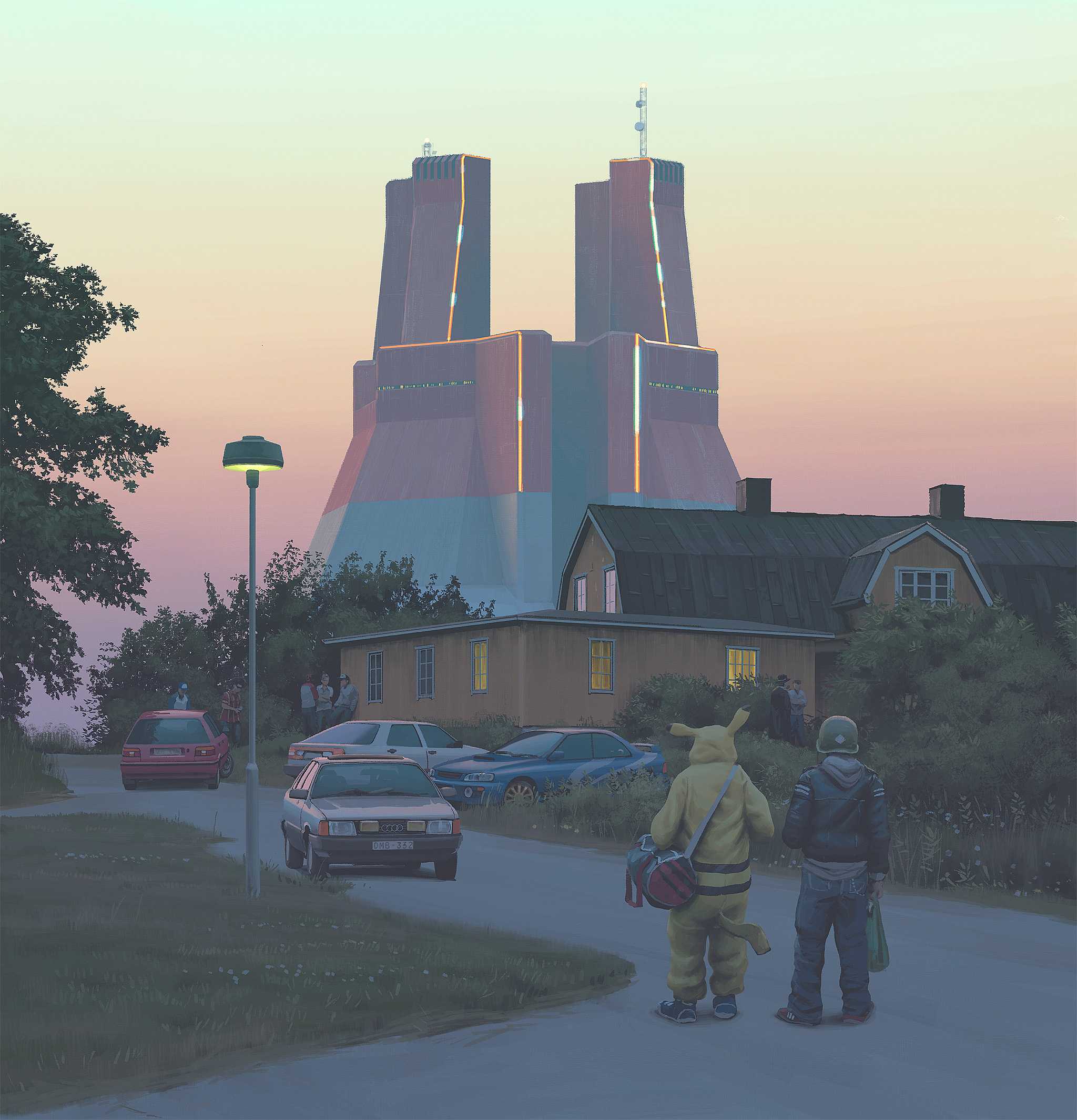
This is the fourth book by Simon Stålenhag for me this year (which is not about reading a lot, as these are coffee-table books more full of gorgeous art than text, but an indication of my adoration of Stålenhag’s work). Each is set in an alternate Sweden, where imagined experiments with radical science have left behind environmental transformation and legacies of technological contamination on the local area: derelict-yet-futuristic vehicles, altered landscapes, and hazardous sites which bend natural laws. Nevertheless, the science-fiction plays as mellow backdrop and locals interact with everything in an ordinary, day-to-day fashion. To them it seems very normal, while we readers admire how extraordinary it all is.
Experienced in sequence, Stålenhag’s books started out with less story, and more as narrative flashes and descriptive glimpses which built up this alternate world from loosely connected pieces. With The Electric State, there was more of a plot, and a set of protagonists who went on a quest to reach the coast. Now with Sunset at Zero Point (which was titled “Swedish Machines” in its original Kickstarter edition), we are exclusively following the story of two young men, Linus and Valter, and their relationship over a few decades. They live in the small town called Torsvik, which is on the edge of an exclusion zone which was once contaminated by the development and testing of a major weapon known as the Tetrahedron. After the failure of that work, the area was closed off and left to be managed by the company that Valter works for as a security guard. He is very interested in the heart of this zone, known as the Black Fallow, and sneaks out with the company vehicle, equipment and brings Linus along, to explore and scavenge.
The entire book is told to us by Linus, talking to Valter (so it’s an oddly second-person perspective), which was a bit strange to me at first (especially when Linus would say “you said” and quote to Valter something that he said). However, I would say that it works, especially given how close the two become over the years. Most of the first half of the story foregrounds the burgeoning romantic/sexual aspects of their relationship. However, I was a bit disappointed in how much time was spent with them (and their other “horny teenager” friends) as they goof around, attend music festivals and Halloween parties. While the expression “Dude!” was never uttered, its spirit was strongly felt for most of the early portions of the book. The context of Torsvik existing on the edge of the exclusion zone and in proximity to the Black Fallow seemed to be a very miniscule portion of the story up to that point. It got me worried that Stålenhag was trying to lean more into mundane character-based storytelling and abandoning the atmospheric science-fiction aspects he is known for, after he’d hooked his readers in. Thankfully the latter third of the book was where things kicked into gear from that perspective. Information that Valter had collected from the zone led the two boys to discover something that was (in classic Stålenhag fashion) universe-altering; but in the context of this story meaningful and significant only to the people around the phenomenon: our two protagonists. Though I had doubted him, Stålenhag manages to bring something cosmic down to the level of the personal for these two characters.
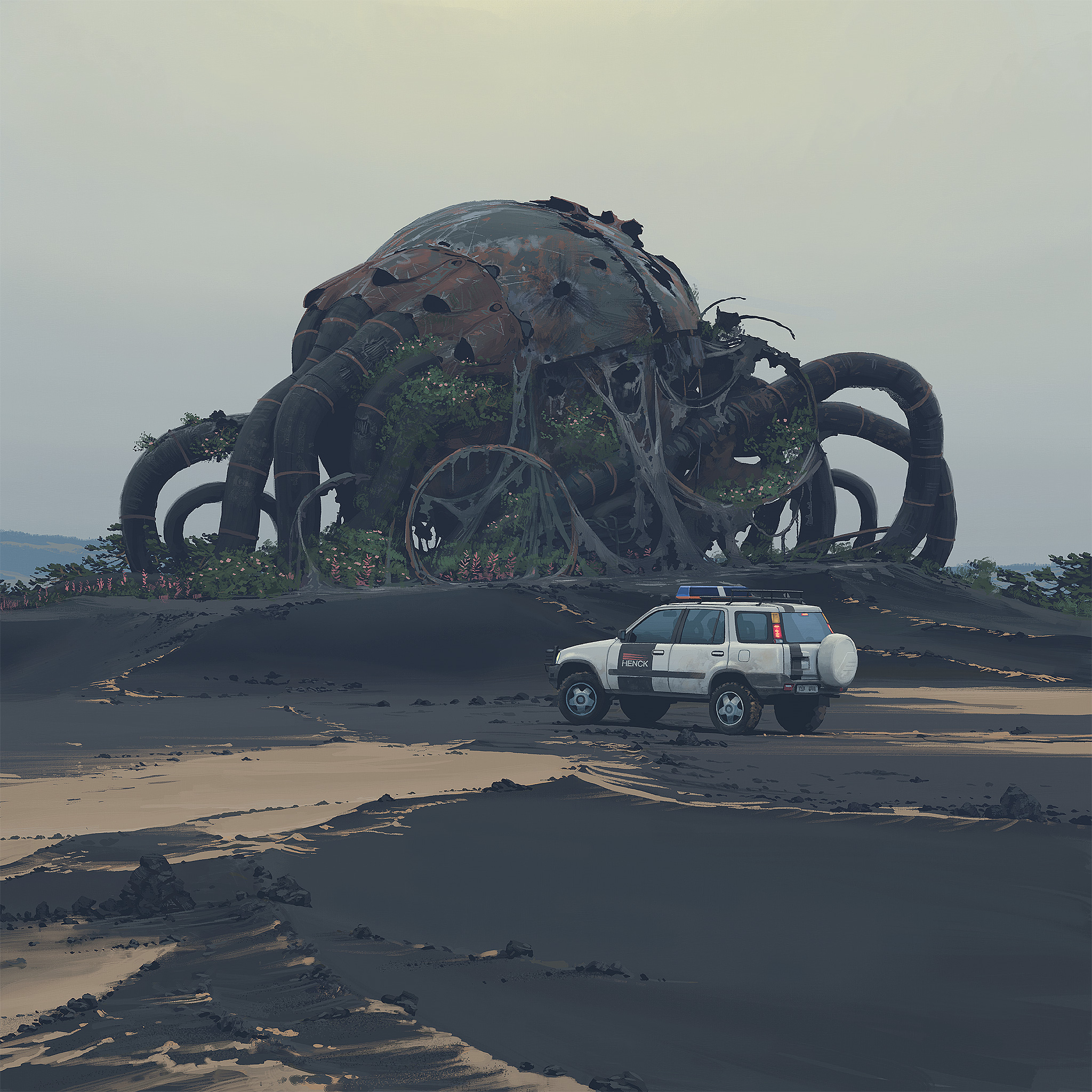
As expected, in this book, Stålenhag’s accompanying art does a masterful job of drawing the reader into this universe. Unlike in previous books, where the images were not necessarily one-to-one matches with what was described in the text, this time the images serve to illustrate events and scenes from the story. However, they’re almost never action shots or even key moments, often depicting instead the location or surroundings before or after the main scene occurs. On the other hand, because the text focuses on Linus and Valter’s story exclusively, there are a lot of similar-looking images of the landscape that the two see on their journey into the Black Fallow and, compared to previous books, less of the diverse sci-fi elements that the zone may contain (no robots or dinosaurs or stuff like that this time). Nevertheless, these vividly painted images of an imagined reality are still very immersive and do a great job of telling the story on their own, as well as with the text.
Overall, I was very engaged and invested in this story, despite how intimate the scope of it was. I would have preferred a more expansive look at the exclusion zone and what else it had done to this region, generally a more sci-fi heavy story. Still, I really enjoyed the ending and how it tied the story of the relationship of these two boys to the phenomenon in the Black Fallow. I also really like this character-driven direction that Stålenhag is continuing to develop in his books. If this story gets picked up for adaptation as well, I think it will make a great arthouse science fiction film that I would be eager to see.
3.5 stars
Please join me on GoodReads and follow what I’m reading: https://www.goodreads.com/user/show/78985113-alvin-ng
Or join me on Fable: https://fable.co/alvin-ng-324926061648
 Alvin's Adventures in Pop Culture